
Here’s something parents tell us often: their child knows something is wrong, but they can’t explain it. They don’t have the words. Sometimes they’re too young to have the vocabulary. Sometimes the feeling is so big it won’t fit into language at all.
This is not unusual. It is developmentally normal. Children’s brains are still building the capacity for emotional articulation well into adolescence, which means asking a struggling child to describe their inner world in words is sometimes asking for something they genuinely cannot give.
Art therapy meets children where they actually are.
At The Family Center of Maine, art therapy is one of the specialized therapeutic approaches we use with children across our southern Maine offices. It is part of a broader child counseling framework that includes play-based therapy, cognitive behavioral therapy, and other evidence-informed methods. The goal is always the same: to give children a safe, supported path toward healing that respects how they actually process the world.
What Art Therapy Is, and What It Isn’t
Art therapy is not art class. The child’s skill as an artist is completely irrelevant. Nobody is grading the drawing. Nobody is looking for technical merit.
What the therapist is doing is paying attention to something different entirely: what themes emerge, what colors a child gravitates toward, how they approach the blank page, what they say while they’re creating, and what they avoid. The creative process becomes a window into the emotional experience that words haven’t reached.
The American Art Therapy Association describes art therapy as an integrative mental health profession that uses the creative process of art-making to improve and enhance physical, mental, and emotional well-being. Decades of clinical research support its effectiveness across a range of childhood challenges, including trauma, anxiety, behavioral issues, and grief.
For kids who have experienced something difficult and can’t talk about it directly, art provides an indirect route. A child might draw a scene from a nightmare repeatedly. Another might use clay to build and then destroy the same structure over and over. A therapist trained in this approach doesn’t interrupt these processes. They observe them, engage gently around them, and over time help the child move toward understanding and resolution.
The Children Who Benefit Most
Broadly speaking, art therapy is beneficial for most children in a therapeutic setting. But there are a few groups where it tends to be particularly powerful.
Children who’ve experienced trauma often find art therapy a gentler entry point than talk therapy. Trauma can make direct verbal discussion feel threatening. Creating something is a way of approaching the experience without having to face it head-on. Our team uses trauma-informed approaches throughout, and for many of these children, art is the bridge.
Children with autism or ADHD often respond strongly to structured creative activities. The tactile and visual engagement of art-making can support focus and regulation in ways that a traditional talk-based session might not. At our practice, art therapy is one of the tools we use alongside approaches like Autplay Therapy and other neurodivergent-affirming modalities.
Children processing grief or loss use art to externalize feelings they don’t know how to name. Drawing a person who has died, creating a memory box in session, or making something as a tribute are all ways that children use creative expression to metabolize loss. It is genuinely moving to witness.
Children with social anxiety often find the focus of making something gives them a kind of social scaffolding. Interaction happens around the activity rather than being the activity itself, which reduces the pressure considerably.
What a Session Looks Like
Parents understandably want to know what actually happens in the room. Here’s what I can tell you in general terms.
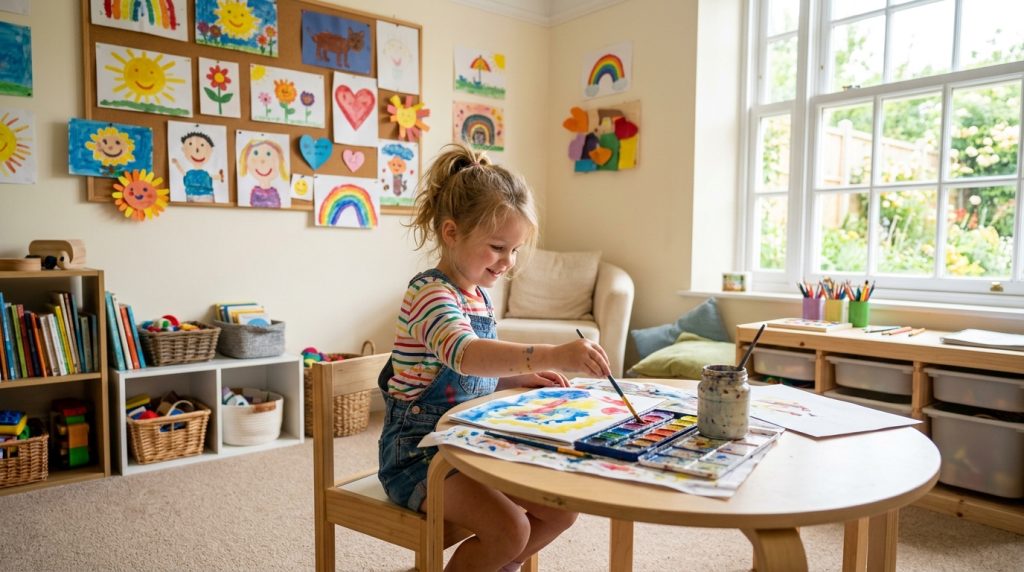
The space is set up to feel inviting and low-stakes. There are materials available, but the child is not required to use any particular one. Some children arrive and immediately pick up a marker. Others take several sessions before they engage with materials at all, and that’s completely okay.
The therapist builds a relationship first. Trust is the foundation of any therapeutic work, but it is especially critical with children. A child who doesn’t feel safe with the adult in the room won’t create freely, and the creative freedom is where the therapeutic work lives.
As sessions progress, the therapist begins to notice patterns. They might gently reflect something back: “I notice the figure in your drawing always has their back turned. Tell me about that.” Or they might simply create alongside the child, using their own art-making to model that expression doesn’t require perfection.
Parents are often curious about what comes from these sessions, and we believe in keeping caregivers meaningfully informed. Our therapists work collaboratively with families to ensure the work in the room is connected to the support happening at home.
How Art Therapy Connects to Our Broader Approach
At The Family Center of Maine, art therapy does not operate in isolation. It is one part of a broader set of clinical tools our child therapists draw from, including child-centered play therapy, Synergetic Play Therapy, and Cognitive Behavioral Therapy adapted for children.
We treat each child as an individual. The combination of approaches used in any given case depends on that child’s age, diagnosis if applicable, presenting concerns, and what the therapist observes is actually working in the room. One child might move quickly through art-based work and into more structured CBT techniques. Another might need months of creative processing before other approaches become accessible.
This flexibility is the point. We are not running children through a program. We are building a therapeutic relationship that serves this particular child.
Finding Child Therapy Support in Southern Maine
If you’re a parent in southern Maine who’s wondering whether art therapy might be right for your child, the honest answer is: it depends on the child. That’s not a dodge. It’s the truth. What we can tell you is that a qualified child therapist will assess what approaches are most likely to help your child and will adjust as the work unfolds.
Research from the Child Mind Institute supports creative and play-based approaches as effective interventions for a wide range of childhood mental health challenges, particularly when children are not yet developmentally ready for traditional talk therapy.
The Family Center of Maine has offices in South Portland, Dunstan Crossing, and Saco. Our child counseling team works with children addressing autism, ADHD, trauma, social anxiety, mood disorders, and more.
If your child is struggling and words aren’t getting you there, art might be a different kind of opening. Reach out through our contact page and let’s talk about what support might look like for your family.